


Ninety days felt like a finish line.
I remember staring at that number like it meant I had finally crossed into a different life. Ninety days sober. Ninety days since detox. Ninety days since the last lie, the last scramble, the last morning of panic.
Everyone told me it was huge.
And it was.
But what no one really prepared me for was what came after.
If you completed Opioid Addiction Treatment and made it past those early months — especially if you relapsed somewhere after — I want to talk to you as someone who has sat in that exact space.
Not as a spokesperson.
Not as a success story.
Just as someone who thought 90 days would feel different than it did.
The High of Early Recovery
The first 30 days are survival.
The first 60 are stabilization.
By 90, you’ve built momentum.
There’s structure. Appointments. Meetings. People checking in. You’re learning how to sleep again, how to eat regularly, how to sit in your own skin without escaping it.
There’s something powerful about those early milestones. You feel seen. You feel proud. You feel like you’re outrunning something.
And then, slowly, that intensity fades.
Not because you failed.
Because life resumes.
When the Applause Gets Quieter
Around that three-month mark, something subtle shifts.
People stop asking how you’re doing every day.
The crisis energy is gone.
You’re expected to function.
And internally? You might feel… underwhelmed.
Maybe you expected more clarity.
More happiness.
More relief.
Instead, you might feel tired. Flat. Restless.
That doesn’t mean recovery isn’t working.
It means you’re transitioning from crisis mode to maintenance mode.
And maintenance is quieter.
The Identity Problem No One Mentions
In early recovery, “the person getting sober” becomes your identity.
You’re rebuilding. You’re brave. You’re in process.
After 90 days, that identity starts to fade. You’re not the new person in treatment anymore. You’re just… you.
Work stress comes back. Relationship tension resurfaces. Bills don’t disappear. Trauma doesn’t vanish because you hit a milestone.
And for some of us, that normalcy feels disorienting.
Addiction brought chaos.
Early recovery brought urgency.
Middle recovery brings routine.
Routine can feel boring. And boring can feel dangerous when your brain is used to intensity.
The Emotional Dip Between 90 and 180 Days
This stretch doesn’t get talked about enough.
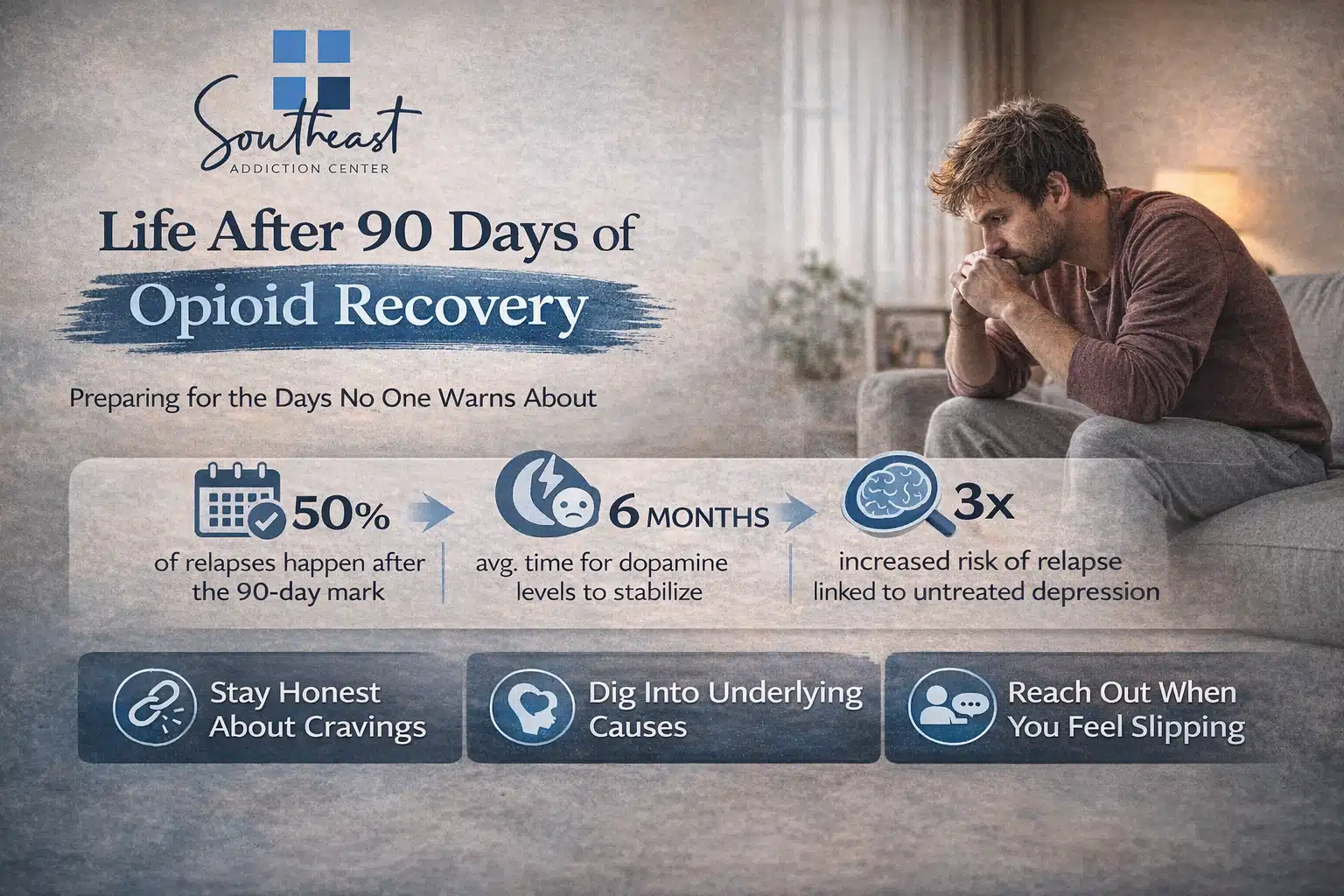
Biologically, your brain is still healing. Dopamine regulation is improving but not fully restored. Your stress response is recalibrating.
Emotionally, you may notice:
- Less excitement about sobriety.
- More irritability.
- A sense of “Is this all there is?”
- Subtle cravings that don’t feel urgent — just persistent.
It’s not dramatic. It’s quiet.
And quiet discomfort can be harder to recognize than chaos.
I remember thinking something was wrong with me because I wasn’t glowing with gratitude.
What I was actually experiencing was the middle.
And the middle is uncomfortable.
When You Slip After 90 Days
If you relapsed after three months — or close to it — you probably felt something sharp and immediate.
Shame.
“I knew better.”
“I had it.”
“I ruined it.”
That narrative is brutal.
But here’s something I wish someone had said to me sooner:
Relapse after progress does not erase the progress.
It exposes where support thinned out.
Sometimes we step down from structure too quickly. Sometimes we stop talking about cravings because they feel embarrassing. Sometimes we overestimate how healed our nervous system is.
Relapse is information.
Painful information — but information.
It tells you what still needs reinforcement.
You are not back at zero.
The Grief No One Warns You About
There’s grief in recovery.
Grief for the chaos.
Grief for the escape.
Grief for the part of you that felt invincible.
Even if addiction was destroying your life, it also served a purpose. It numbed something. It energized something. It created intensity.
Letting go of that intensity can feel like losing a relationship.
And you’re not supposed to miss it — but sometimes you do.
I missed the way everything felt amplified. I missed the predictability of knowing exactly how to change my mood in seconds.
Admitting that didn’t mean I wanted to go back.
It meant I was being honest.
Grief ignored becomes relapse risk.
Grief acknowledged becomes growth.
The Danger of “I Should Be Fine By Now”
After 90 days, there’s a quiet pressure.
You should be grateful.
You should be stable.
You should be stronger.
When cravings return or mood dips hit, it can feel like you’re defective.
But healing doesn’t follow a calendar.
Some people need extended multi-day weekly treatment longer than expected. Some need to re-engage structured daytime care when stress spikes. Some need to address underlying anxiety or depression more directly.
Recovery is not linear.
If you’re in Georgia and feel like your footing is slipping, there is ongoing support in Georgia that understands this phase — not just detox and not just crisis.
You don’t have to wait for disaster to ask for reinforcement.
The Lie That “I Already Tried”
One relapse can turn into a dangerous thought pattern.
“I tried treatment. It didn’t stick.”
“Maybe I’m just not built for this.”
But here’s what’s real:
Treatment isn’t a single event. It’s a foundation.
Sometimes that foundation needs reinforcement. Sometimes it needs more time. Sometimes the level of care wasn’t quite right.
Going back doesn’t mean you failed. It means you’re adjusting the plan.
You are allowed to return without shame.
What Actually Strengthens Recovery After 90 Days
In my experience — and in watching others — this stage requires intentional connection.
That might mean:
- Increasing honesty about cravings.
- Re-engaging therapy if you drifted.
- Revisiting coping tools instead of assuming you’ve mastered them.
- Addressing boredom directly instead of pretending it’s trivial.
- Staying close to people who understand recovery language.
This is where recovery becomes less about survival and more about building a life.
But building takes patience.
You Didn’t Lose Everything
If you’re reading this after a slip, hear me clearly:
You did not throw away your progress.
Those 90 days rewired something. They proved you can stabilize. They showed you what life feels like without daily chaos.
That memory matters.
You are not disqualified from hope.
You are in the messy middle.
And the messy middle is where resilience forms.
Frequently Asked Questions
Is it normal to feel worse emotionally after 90 days?
Yes.
As your brain recalibrates, emotions that were previously numbed may surface. This can include sadness, irritability, anxiety, or restlessness.
This phase doesn’t mean recovery isn’t working. It often means deeper healing is happening.
Why did cravings return after they were gone?
Cravings are influenced by stress, environment, emotional triggers, and neurobiology.
Even after initial stabilization, your brain may still associate certain situations with relief. Cravings don’t mean failure — they signal vulnerability points.
Support during this phase is crucial.
Does relapse mean I need to start completely over?
No.
Relapse is a setback, not a reset button.
What matters most is how quickly you re-engage support. Many people build stronger recovery after a relapse because they better understand their triggers.
Should I go back to treatment even if it feels embarrassing?
Yes.
Embarrassment is temporary. Stability is long-term.
Programs understand that recovery includes setbacks. Reaching out again shows courage, not weakness.
How do I know if I need a higher level of care again?
If cravings feel overwhelming, if use has resumed regularly, or if mental health symptoms are escalating, it may be time to consider more structured support.
An honest assessment can clarify whether multi-day weekly treatment is enough or if more intensive care is needed.
What if I feel disconnected but haven’t relapsed?
That’s important.
Emotional flatness, boredom, or detachment are risk factors. Re-engaging support before relapse is proactive, not dramatic.
Prevention is strength.
If You’re Quietly Struggling Right Now
If you made it to 90 days and feel disappointed…
If you relapsed and feel ashamed…
If you’re somewhere between stable and slipping…
You are not alone in this stretch.
The middle of recovery is less glamorous than the beginning. But it’s where depth grows.
You don’t have to carry this quietly.
Call 888-981-8263 or visit our page on Opioid Addiction Treatment services in Georgia to reconnect, recalibrate, or simply talk honestly about where you are.
You didn’t ruin everything.
You’re still building.
And the story isn’t over.