
Residential Treatment Program
What “Sober Curious” Really Means

Written By
You haven’t “hit bottom.”
You’re not waking up in a ditch.
You’re functioning.
And still… something feels off.
Maybe you’re sober curious. Maybe you’ve started questioning your relationship with alcohol or substances. Maybe you’ve already tried cutting back — and you’re realizing it’s harder than you expected.
If you’ve quietly searched for a residential treatment program and immediately thought, “That seems extreme… but what if?” — this is for you.
Let’s slow it down and walk through how to decide.
Most people don’t begin with: “Do I need treatment?”
They begin with:
Sober curiosity often starts as experimentation. But if your experiments keep circling back to the same frustration, that’s worth listening to.
If alcohol or substances are taking up more emotional bandwidth than you’re comfortable admitting, that’s not dramatic. That’s data.
Live-in treatment isn’t about proving you’re “bad enough.” It’s about asking whether stepping away could finally quiet the noise.
You might not be spiraling.
But are you exhausted?
High-functioning people are often the last to consider immersive care because life still looks intact on paper.
Work gets done.
Family responsibilities are handled.
No one’s staging an intervention.
But inside, you might be:
That kind of mental load is heavy. And it compounds.
A residential treatment program removes the daily negotiation. For a period of time, the decision is made for you. That relief alone can be transformative.
Sometimes what people are really craving isn’t control — it’s rest.
There’s a difference.
Plenty of people can pause for a few days. But if stopping entirely feels threatening — physically, emotionally, or socially — that matters.
You might notice:
These aren’t moral failures. They’re signs your nervous system may be more reliant than you realized.
Round-the-clock support provides medical oversight and emotional care during that transition. You don’t have to test your limits alone.
And if your body needs stabilization, that’s not weakness. It’s biology.
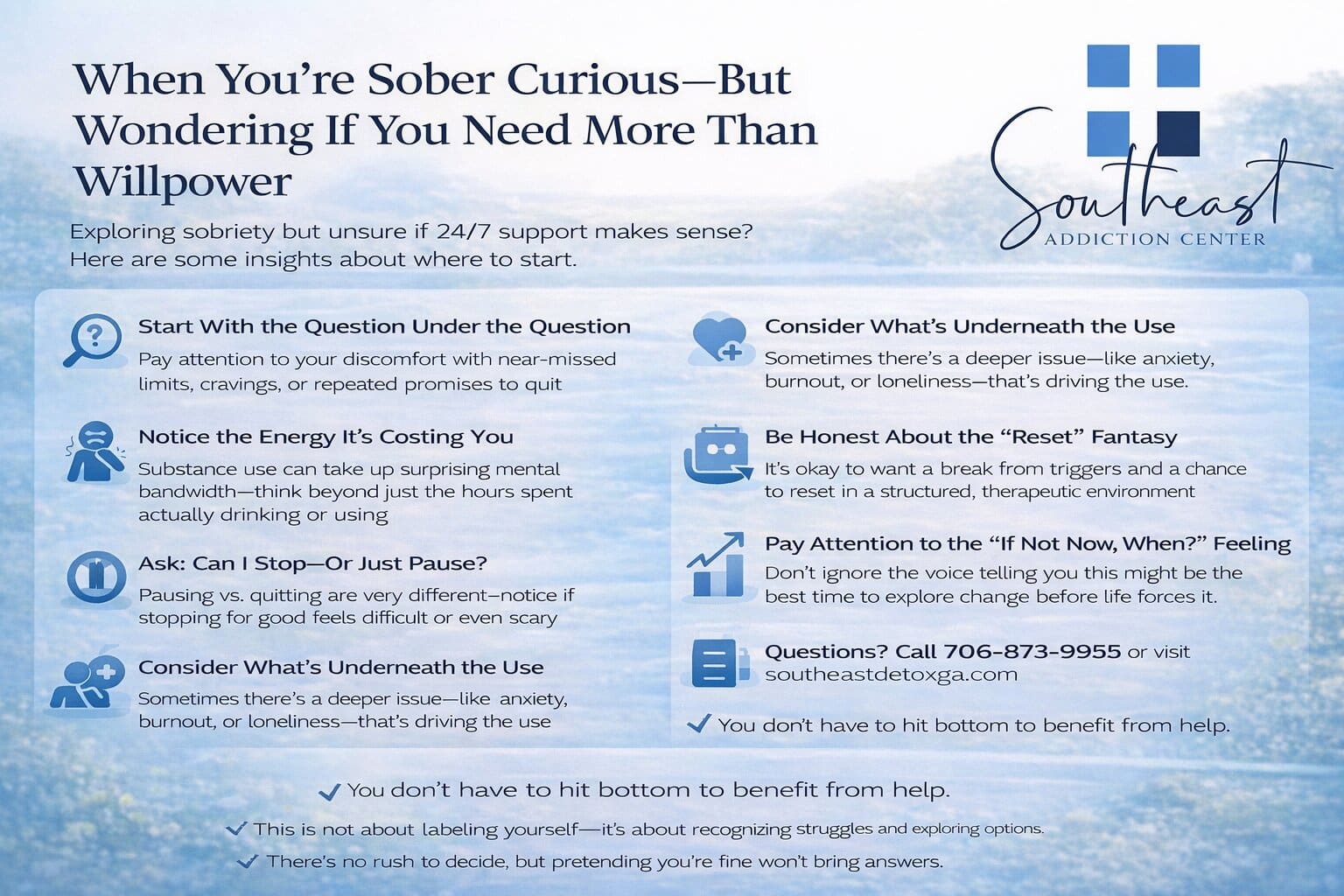
Sober curiosity often uncovers something deeper:
When mental health and substance use start feeding each other, cutting back without support can feel impossible.
Live-in care creates protected space to untangle those layers. Not rushed. Not squeezed between meetings. Not as an afterthought.
You deserve the time to understand yourself — not just manage symptoms.
A lot of sober curious people have a private thought:
“What if I just stepped away from everything for a while?”
Not to escape your responsibilities.
But to reset your baseline.
That desire doesn’t make you irresponsible. It makes you aware that your current pace might not be sustainable.
In immersive care, the outside noise gets quieter:
Just structure. Support. Space.
That distance can feel intimidating — especially if you pride yourself on independence. But sometimes independence becomes isolation.
And healing rarely happens in isolation.
This one is subtle.
You might be functioning well enough to delay the decision. But you also sense the trajectory isn’t improving.
Maybe tolerance is increasing.
Maybe the mental bargaining is getting louder.
Maybe your “rules” are bending more often.
You don’t have to wait for a dramatic event to justify change.
Choosing deeper care early can prevent years of slow erosion — of confidence, health, relationships, and self-trust.
One honest sentence can feel like a lifeline.
Maybe that sentence is: “I don’t want this to get worse.”
It doesn’t mean:
It means you’re willing to invest in your own stability.
A residential treatment program provides:
It’s not about punishment. It’s about building a foundation that doesn’t rely on white-knuckling.
And if you’re exploring treatment options in Metro Atlanta, Florida, it’s okay to simply ask questions. Curiosity is enough to start a conversation.
No. Many people enter care because they’re questioning their relationship with substances — not because they’ve adopted a label. Treatment is about behavior patterns and quality of life, not identity politics. If something isn’t working, you’re allowed to explore change.
Functioning doesn’t always mean thriving. High-functioning individuals often carry silent stress and shame. Immersive care can help you address patterns before they escalate into visible consequences. You don’t have to wait for collapse to justify support.
Length of stay varies based on your needs, goals, and clinical recommendations. Some people benefit from shorter stabilization periods. Others choose longer stays to fully reset habits and address underlying mental health concerns. The right timeline is personalized — not predetermined.
That fear is normal. We help clients plan for work leave, family communication, and logistical details before admission. Many people find that stepping away briefly protects their long-term responsibilities more than continuing in survival mode. Short-term pause. Long-term gain.
It’s not extreme to want your life to feel better. You don’t need DUIs, hospitalizations, or ultimatums to qualify for care. Prevention is powerful. Early intervention is wise. Waiting for disaster isn’t a requirement.
Aftercare planning is part of the process.
That might include:
The goal isn’t to send you back unchanged. It’s to build continuity so your progress has support when you transition home.
Then you’re in exactly the right place to ask questions. You don’t have to be certain. You don’t have to commit immediately. But if you’re reading this and feeling seen, that’s meaningful. Curiosity is often the first honest step.
If something in you keeps whispering, “I want more than this,” listen.
You don’t have to call it addiction.
You don’t have to make a lifelong declaration.
You just have to decide whether staying the same feels sustainable.
If you’re exploring a residential treatment program and wondering what that could look like for you, we’re here to talk it through — calmly, clearly, without pressure.
Call 706-873-9955 or visit our Residential treatment program services in to learn more about your options.
You don’t need a crisis to deserve change.