
Partial Hospitalization Program
How to Recognize the Early Signs That a Partial Hospitalization Program Might Support Your Sobriety Goals

Written By
Partial Hospitalization Program
Written By
You’re not in a crisis. But something’s shifting.
Maybe you’re pouring one glass less. Skipping a night out here and there. Reading about alcohol-free lifestyles or watching recovery stories with unexpected interest. Maybe you’re just quietly wondering: Would I feel better without all of this?
That’s the voice of sober curiosity—and it deserves to be heard. Not dismissed. Not fast-tracked into a label. Just heard.
If you’re exploring change and wondering whether structured support could help, a Partial Hospitalization Program in Peachtree Corners, GA might be worth considering. Not because things are “bad enough.” But because you’re allowed to want better—without hitting rock bottom first.
Here’s how to know if PHP could be the right next step for you.
You’re not out of control. You still get to work. You still show up. But there’s a quiet weight to it all—the planning, the promises, the inner negotiations.
“I’ll only drink on weekends.”
“Just one tonight.”
“I’ll quit after this vacation.”
It’s not chaos. But it’s not peace either.
Partial Hospitalization offers a break from all that mental load. It creates a container—a safe, structured space—where you don’t have to carry it all alone anymore.
In PHP, the goal isn’t to take your life away. It’s to help you rebuild it in a way that feels more honest, less heavy.
This is one of the most common reasons sober curious people hesitate to seek help.
You don’t feel like your use fits the picture of addiction. You haven’t hit rock bottom. You don’t relate to horror stories.
So where does that leave you?
Honestly—right where you are. And right where you belong.
Partial Hospitalization Programs aren’t only for people in severe crisis. They’re also for people in transition. People who sense that something in their relationship with substances is off, even if they can’t name it.
Maybe you’re using to cope. Or to numb. Or just out of habit. And now you’re wondering who you are without it.
That question alone is enough to start.
From the outside, everything might look okay. You’re functional. Stable. Social.
But inside? It’s like you’re watching your own life through a screen—just slightly removed.
Substances can dull more than pain. They can dull joy, clarity, connection, even creativity.
In PHP, you’ll work with therapists and peers to understand what’s underneath that fog. You’ll explore your patterns, your triggers, and—maybe most importantly—what you want from your life moving forward.
The goal isn’t just to stop drinking or using. It’s to help you feel more like you again.
Dry January. Mindful drinking. Breaks. Boundaries.
You’ve dabbled in all of it, and maybe it helped for a while. But the deeper shifts—the emotional clarity, the lasting change—still feel out of reach.
That doesn’t mean you failed.
It might just mean you’ve reached the limit of what self-guided change can offer. PHP meets you there—with structure, support, and zero judgment.
In our program, you don’t have to navigate the hard stuff alone. You’ll have licensed clinicians, group support, and time each day dedicated to unpacking what’s actually going on under the surface.
This is where curiosity becomes growth.
One of the scariest things about seeking help—especially if you’re not in a full-blown crisis—is the fear of losing your sense of self.
What if I stop drinking and get boring?
What if I don’t fit in with “sober people”?
What if this changes everything?
Those are real questions. PHP isn’t here to force identity labels or fast-forward your process.
Instead, it offers space to explore. With no pressure to define yourself, no one-size-fits-all plan, and no assumption about what you “should” want.
In our Peachtree Corners PHP, we work with people who are rebuilding their relationship to substances on their own terms. Whether your goal is sobriety, moderation, or just clarity—you’re welcome here.
In early sobriety or substance shifts, unstructured time can become a minefield.
You want to feel better, but your days are full of stress, triggers, or just plain boredom. And when life is loud, substances can feel like the quickest mute button.
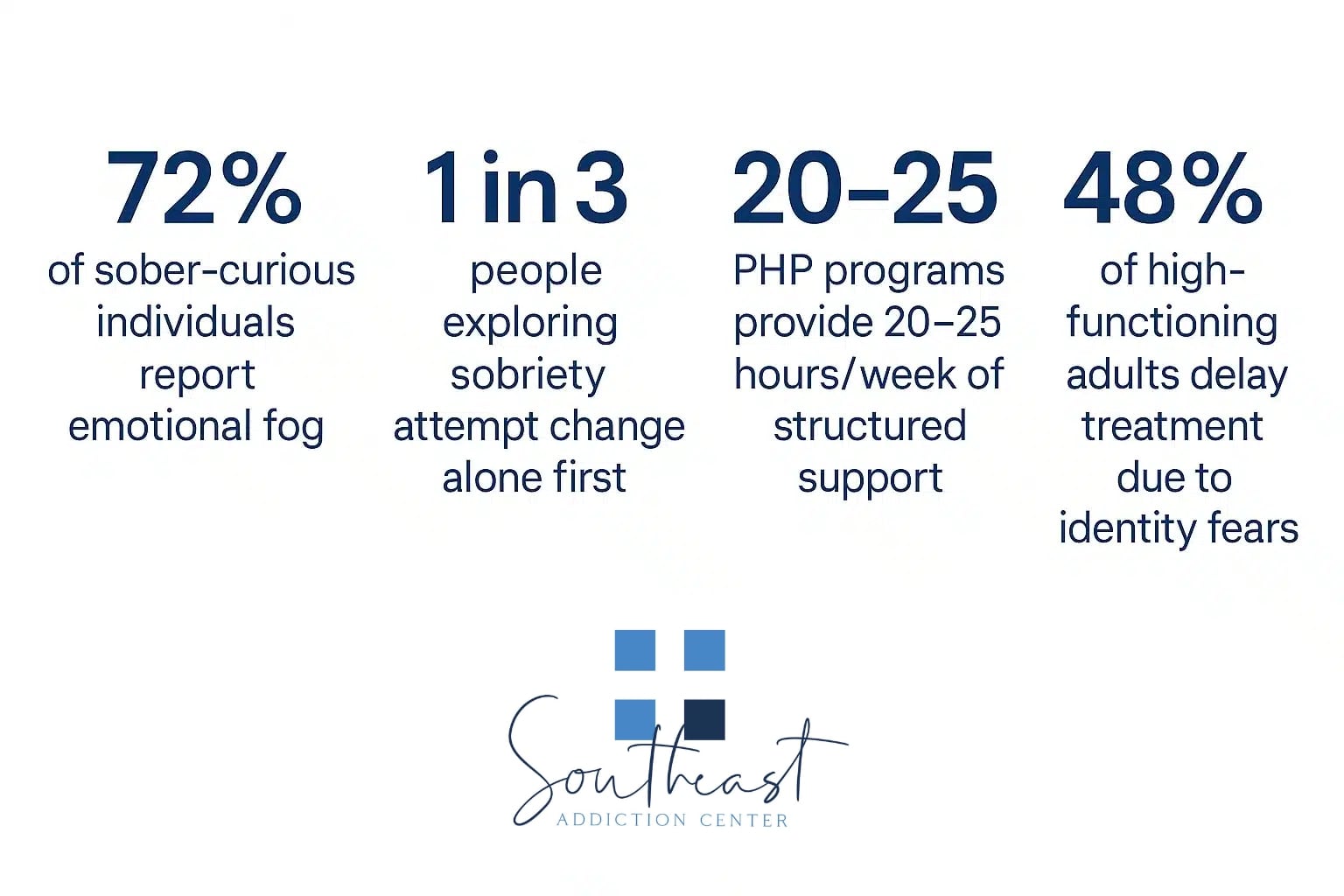
PHP provides 20–25 hours a week of focused care. That means time for therapy, group work, emotional processing, skill-building—and breaks.
It’s intensive, yes. But it’s also deeply nurturing.
Think of it as scaffolding while you rebuild. Temporary support that makes change not only possible—but sustainable.
When you slow down your use, other things start to rise to the surface. Old pain. Emotional avoidance. Identity questions. Career uncertainty. Relationships that feel misaligned.
These questions aren’t problems. They’re invitations.
And in PHP, you’ll have the support to face them.
This isn’t just behavior change. It’s soul work. It’s choosing to listen to yourself more deeply than you ever have before.
And you don’t have to do it alone.
At Southeast Addiction’s Partial Hospitalization Program in Peachtree Corners, GA, we create a space that’s structured enough to support you, but flexible enough to respect your autonomy.
You’ll have access to:
You’ll return home in the evenings, allowing you to stay connected to your real life while receiving real-time support.
Most importantly: there’s no pressure to be anyone other than exactly who you are today.
No. Many people come to PHP unsure of their long-term goals. Our team will help you explore your relationship to substances and clarify what healing looks like for you.
Not at all. PHP is appropriate for people dealing with emotional distress, substance use patterns, or simply feeling stuck. You don’t need a specific label to get support.
Yes. We meet you where you are. If you’re willing to explore change and show up honestly, that’s all we ask. Many of our clients begin treatment while still in early stages of change.
Residential programs require you to live at the facility. PHP allows you to return home each night, giving you flexibility and the chance to apply what you’re learning in real life.
PHP requires a significant time commitment (usually weekdays, 5–6 hours/day), so many people adjust work hours temporarily or take short leave. We can help with documentation if needed.
Yes—many clients do. Our team is happy to coordinate care with your outside providers.
Not at all. PHP includes group sessions, but also individual therapy, psychoeducation, wellness activities, and personal reflection time.
Choosing PHP doesn’t mean you’ve “crossed a line.” It means you’re choosing to invest in your well-being before things reach a breaking point.
That’s strength. That’s wisdom. That’s healing before harm.
Ready to explore your next step?
Call 888-981-8263 or visit our Partial Hospitalization Program page to learn more about how we support sober curious individuals in Peachtree Corners, GA.
We’d be honored to help you figure out what’s next—on your terms, at your pace.