
Medical Detox
The Slow Burn of Functional Addiction

Written By
You’re not waking up in a ditch.
You’re waking up at 6:00 a.m., answering emails before your feet hit the floor.
You’re not missing meetings. You’re not getting DUIs. You’re not “that person.”
But you are tired. Bone-deep tired. The kind of tired that comes from managing two lives—the one everyone sees and the one you’re trying to control.
As a clinician, I’ve worked with executives, nurses, parents, small business owners—people who looked steady from the outside. Many of them eventually found themselves researching a medical detox program in Georgia.
Not because everything fell apart.
Because they couldn’t keep holding it together.
High-functioning substance use doesn’t usually start with chaos.
It starts with relief.
A drink that softens the edge after work.
A pill that helps you sleep.
Something that makes social events easier.
At first, it works.
Then your brain adapts.
You need a little more. A little earlier. A little more often.
You tell yourself:
But here’s the shift I see over and over:
You stop using for enjoyment.
You start using to feel normal.
That’s the quiet turning point.
I want to say something directly.
Keeping your job does not mean your body is okay.
Providing for your family does not mean your nervous system isn’t overloaded.
Being productive does not mean you’re stable.
In fact, high performers often last longer in active addiction because they can compensate.
They push through hangovers.
They mask anxiety.
They use discipline to hide dependence.
But biology always wins.
If your body has adapted to daily alcohol, benzodiazepines, or opioids, stopping suddenly can cause:
This isn’t about weakness.
It’s about chemistry.
And chemistry requires medical care—not grit.
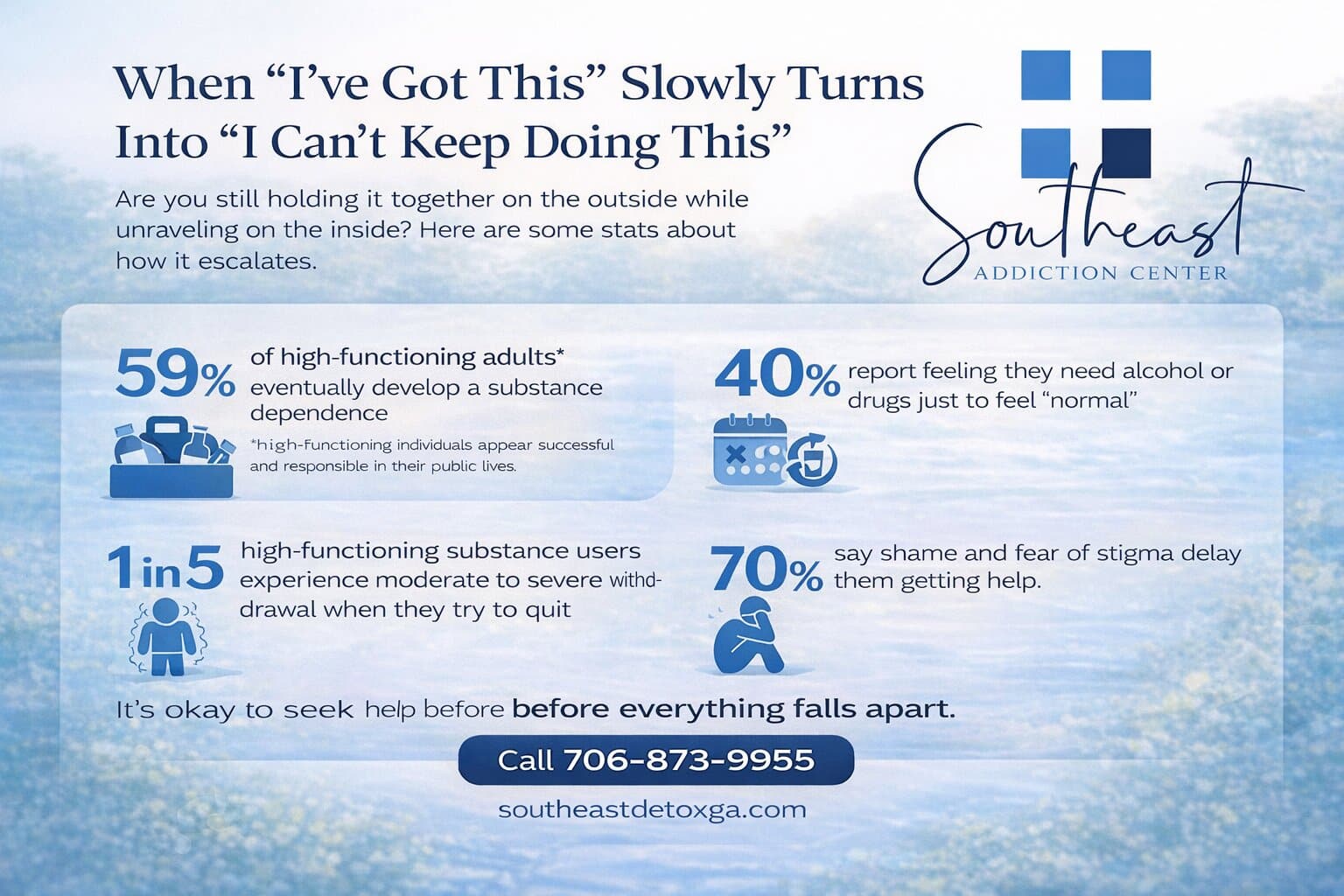
You don’t have to identify as “an addict” to notice patterns.
You might be dealing with physical dependence if:
Many high-functioning people tell me, “I’m not out of control.”
And they’re right.
They’re not chaotic.
They’re controlled by something.
That’s different.
Here’s what I often hear behind closed doors:
“I’m not failing, but I’m not okay.”
“I can’t imagine not using—but I hate that I need it.”
“If people knew how much I actually drink, they’d be shocked.”
The shame isn’t loud.
It’s quiet and constant.
And because you’re competent, people assume you’re fine.
Which makes it harder to admit you’re not.
One of my clients once said:
“I feel like I’m running a successful company during the day and negotiating with my own brain at night.”
That negotiation gets exhausting.
For high-functioning adults, the instinct is to handle it privately.
You research taper schedules.
You promise yourself this weekend will be different.
You power through two miserable days and then cave because your body revolts.
The truth is:
Alcohol and benzodiazepine withdrawal can be medically dangerous.
Opioid withdrawal, while often not fatal, can be intensely destabilizing and increase relapse risk.
When someone enters a medical detox program, the goal isn’t drama.
It’s safety.
It’s monitoring vitals.
It’s managing symptoms.
It’s reducing the shock to your nervous system.
It’s letting your brain recalibrate without putting you at risk.
For many high-functioning professionals, that first medically supported step is the first time they stop performing and start stabilizing.
There’s a dangerous myth that detox is for people who’ve “lost everything.”
I’ve worked with:
They didn’t lose their lives.
They lost their peace.
And that was enough.
If you’re in or around Metro Atlanta and you’re quietly questioning whether your use has crossed a line, there is confidential, discreet support in Metro Atlanta designed for people exactly like you—people who need competence, privacy, and medical oversight.
You do not need public collapse to justify private care.
Most high-functioning clients tell me the hardest part wasn’t detox.
It was making the call.
Once they arrived, something unexpected happened.
They exhaled.
No more hiding bottles.
No more calculating doses.
No more pretending everything was fine.
Just medical professionals monitoring symptoms, adjusting care, and helping their body stabilize.
Detox doesn’t solve everything.
But it creates space.
Space to think clearly.
Space to sleep.
Space to decide what comes next from a regulated nervous system—not a panicked one.
And for someone who has been holding it together for years, that space can feel like oxygen.
If you experience withdrawal symptoms when you try to stop—such as shaking, sweating, severe anxiety, nausea, or insomnia—that’s a sign your body may be physically dependent. A medical assessment can determine whether supervised detox is the safest next step.
Yes. Professional detox programs are confidential. Many clients are working professionals, parents, or community members who require discretion. Your privacy is protected.
The timeline varies depending on the substance, frequency of use, and your overall health. Some detox processes last several days; others may take longer. The goal is stabilization—not rushing.
No. Detox is the first step—focused on safely managing withdrawal. What comes next is a conversation. Some people transition into structured daytime care or live-in treatment. Others step down into multi-day weekly treatment. The decision is collaborative.
Functioning does not cancel out risk. Many high-performing adults are physically dependent while maintaining careers. The real question is not whether you’re functioning—it’s whether your body is safe and your mind is at peace.
That’s common. Withdrawal can be overwhelming without medical support. Trying on your own and struggling does not mean you can’t succeed—it may mean you needed clinical help.
There’s rarely a dramatic movie moment.
It’s usually late at night.
Or early morning.
A thought you can’t shake:
“I don’t want to live like this anymore.”
If you’re exhausted from negotiating with yourself…
If your body feels like it’s running the show…
If you’re performing well but privately unraveling…
You don’t have to wait for everything to fall apart.
You can choose to stabilize before crisis forces you to.
Call 706-873-9955 or visit our medical detox program services in Georgia to learn more about our Medical detox program services in Georgia.