
Intensive Outpatient Program
How to Ask for Help After Leaving an Intensive Outpatient Program Early

Written By
Intensive Outpatient Program
Written By
It happens quietly sometimes. A missed group here, a skipped session there. Maybe you had a hard week. Maybe things started to spiral. Or maybe you just ghosted your Intensive Outpatient Program without meaning to, and now you’re not sure how to come back.
If that sounds familiar, you’re not the only one. It’s more common than you think—and far less disqualifying than it feels.
At Southeast Addiction’s IOP in Peachtree Corners, GA, we’ve seen this before. And we want you to hear this clearly: You’re not too far gone. You’re not too flaky. You’re not beyond help.
You’re still welcome.
Leaving IOP early might feel like failure. But what if it was just a pause?
There are so many reasons people step away from treatment:
No matter why it happened, it doesn’t erase the fact that you tried. And that matters.
A pause in treatment isn’t a character flaw. It’s a moment. And moments can pass. What comes next is yours to choose.
One of the biggest blocks to reengaging in treatment is the fear of having to explain. You might worry:
Here’s what we want you to know: You don’t owe anyone a perfect narrative.
Clinicians aren’t sitting around tallying attendance. They’re trained to understand the complex, messy, deeply human process of recovery. A simple message like:
“I left earlier than I wanted to. Can we talk about what coming back would look like?”
—can open the door wide again.
And if you don’t have the words? That’s okay too. Sometimes just showing up is enough.
If calling feels overwhelming, try starting with a text or email. You don’t need a grand speech or detailed backstory. You can say:
“Hi—I used to be in IOP and I’m thinking about returning. Can someone talk with me?”
Or even:
“I left earlier than I planned. Is it possible to rejoin?”
The person on the other end isn’t expecting perfection. They’re hoping you give yourself permission to try again.
Somewhere along the way, many of us start believing recovery is only for people who follow the rules perfectly. Who never slip, never ghost, never leave early.
That belief is a lie—and it keeps a lot of people suffering in silence.
Good programs—like the one here in Peachtree Corners—expect setbacks. They understand pauses, relapses, avoidance, and ambivalence. These aren’t red flags. They’re normal parts of the process.
That doesn’t mean we ignore them. It means we work with them.
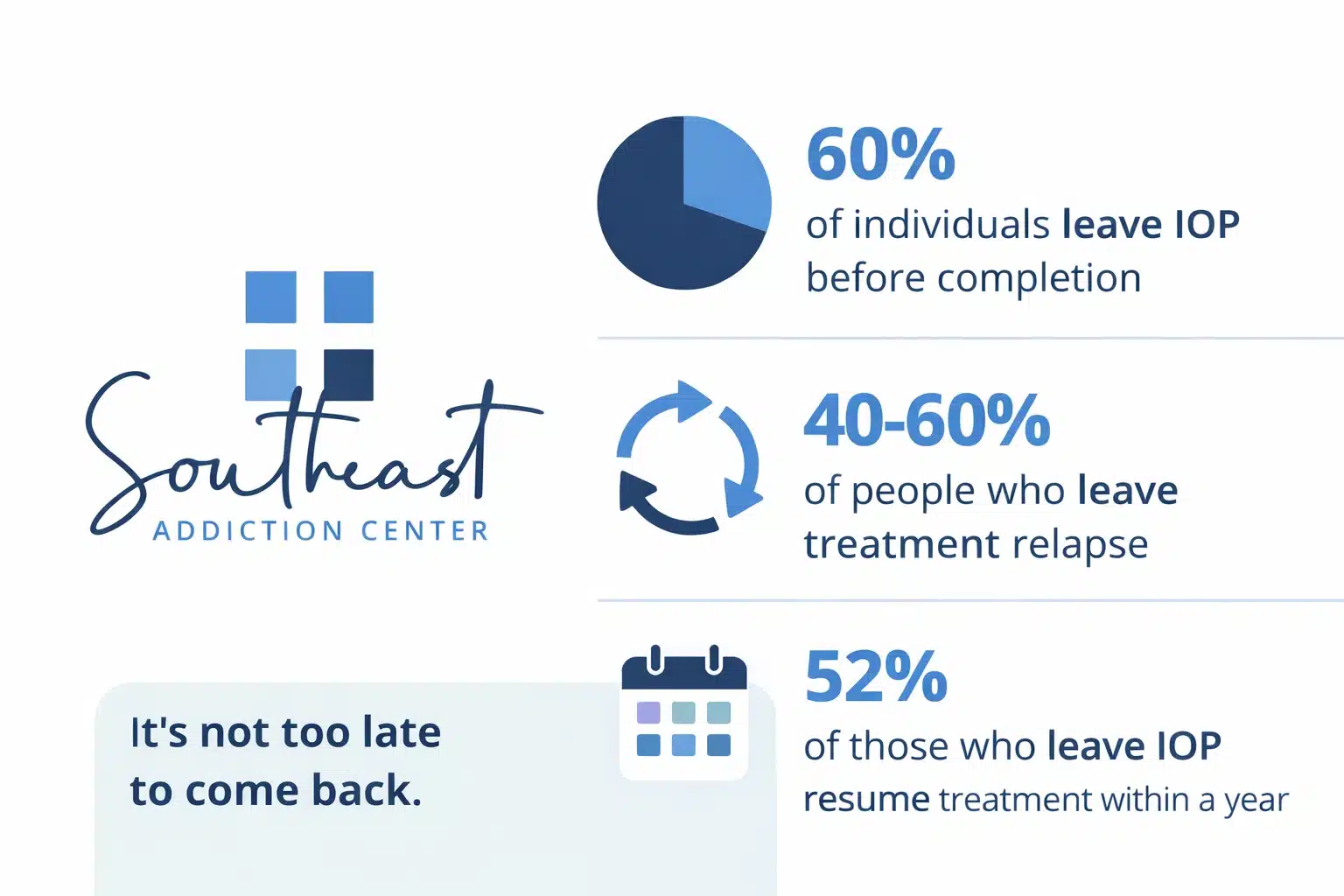
Shame says:
None of that is true.
The longer you sit in guilt, the harder it becomes to reach out. But remember: guilt is just a signal. It tells you that something mattered to you. That your recovery mattered. And that’s good news—because it means it still does.
Worried you’ll have to repeat everything if you come back?
Not necessarily.
At Southeast Addiction, we review your progress and current needs together. If you completed certain groups or made progress on goals, that still counts. You may pick up close to where you left off—or adapt your plan based on what you need now.
Coming back isn’t going backward. It’s reclaiming momentum.
Not sure if you’re ready? That’s okay.
Reaching out doesn’t mean you’ve made a final decision. It just means you’re exploring.
Curiosity counts. You can ask questions, express concerns, or just feel it out.
Many people who reconnect with IOP say the first call back was the hardest part. Once they did, the weight lifted. They remembered they weren’t alone.
Recovery doesn’t move in a straight line. It loops, spirals, and sometimes circles back to places we thought we were done with.
That isn’t failure. It’s integration.
Each time you return to treatment, you come with more insight—even if it feels like you’re starting over. You’re not the same person you were when you left. And you’re allowed to bring everything with you—the progress, the pain, and the pause.
When you contact Southeast Addiction, here’s what won’t happen:
Instead, you’ll get:
This isn’t a disciplinary meeting. It’s a hand extended.
If you’re living in or near Peachtree Corners and looking for a judgment-free place to return, our Intensive Outpatient Program might be the right next step.
We offer:
Whether you left last week, last month, or last year—it’s never too late to reconnect.
Can I come back if I left without telling anyone?
Yes. You don’t need a formal discharge to reach back out. Whether you ghosted or dropped off quietly, you’re still welcome to reconnect.
Will I be judged or turned away for leaving early?
No. At Southeast Addiction, we know that recovery is a winding path. We respond with compassion, not punishment. You won’t be shamed or turned away for stepping back in.
Do I have to restart the entire program?
Not always. It depends on how long you were in the program, your progress, and how long it’s been since you left. Our clinical team will work with you to find a place that makes sense to reenter.
What if I relapsed after leaving?
That’s okay. It’s not uncommon. Relapse doesn’t mean treatment failed—it means something else is asking for support. Coming back is still a strong and courageous choice.
I’m embarrassed. What do I even say when I call?
You don’t have to say much. Try: “Hi, I used to be in the program and I’m thinking about returning. Can we talk?” That’s more than enough to begin.
How soon can I rejoin?
In many cases, quickly. Call us and we’ll walk you through next steps, availability, and what your return could look like.
You’re Still Allowed to Heal
Whether you left suddenly or slowly drifted away—what matters most is this moment. The one where you’re thinking about coming back.
At Southeast Addiction, we know how hard it can be to pick up the phone when guilt is loud and hope is quiet.
Let us carry the hard part with you.
Call 888-981-8263 to talk about rejoining our Intensive Outpatient Program in Peachtree Corners, GA.
There’s still a spot for you. And there always was.