


When your child starts using again, the ache is indescribable.
You thought the worst was behind you. Maybe they’d finished treatment. Maybe they swore they were “done.” For a while, things felt okay. And now, suddenly—or maybe slowly—you’re watching the signs creep back in.
You’re not alone. And this doesn’t mean you failed them. It doesn’t mean they failed either.
At Southeast Addiction, we meet many parents in this exact moment: tired, terrified, and wondering what actually helps now. Often, the answer is a Partial Hospitalization Program—even if that phrase sounds unfamiliar or overwhelming at first.
This blog is for you. The parent who’s trying to stay calm but feels like they’re unraveling inside. We’re going to explain what a PHP is, why it helps young adults who’ve relapsed, and how to know if it’s the right next step.
What Is a Partial Hospitalization Program—Really?
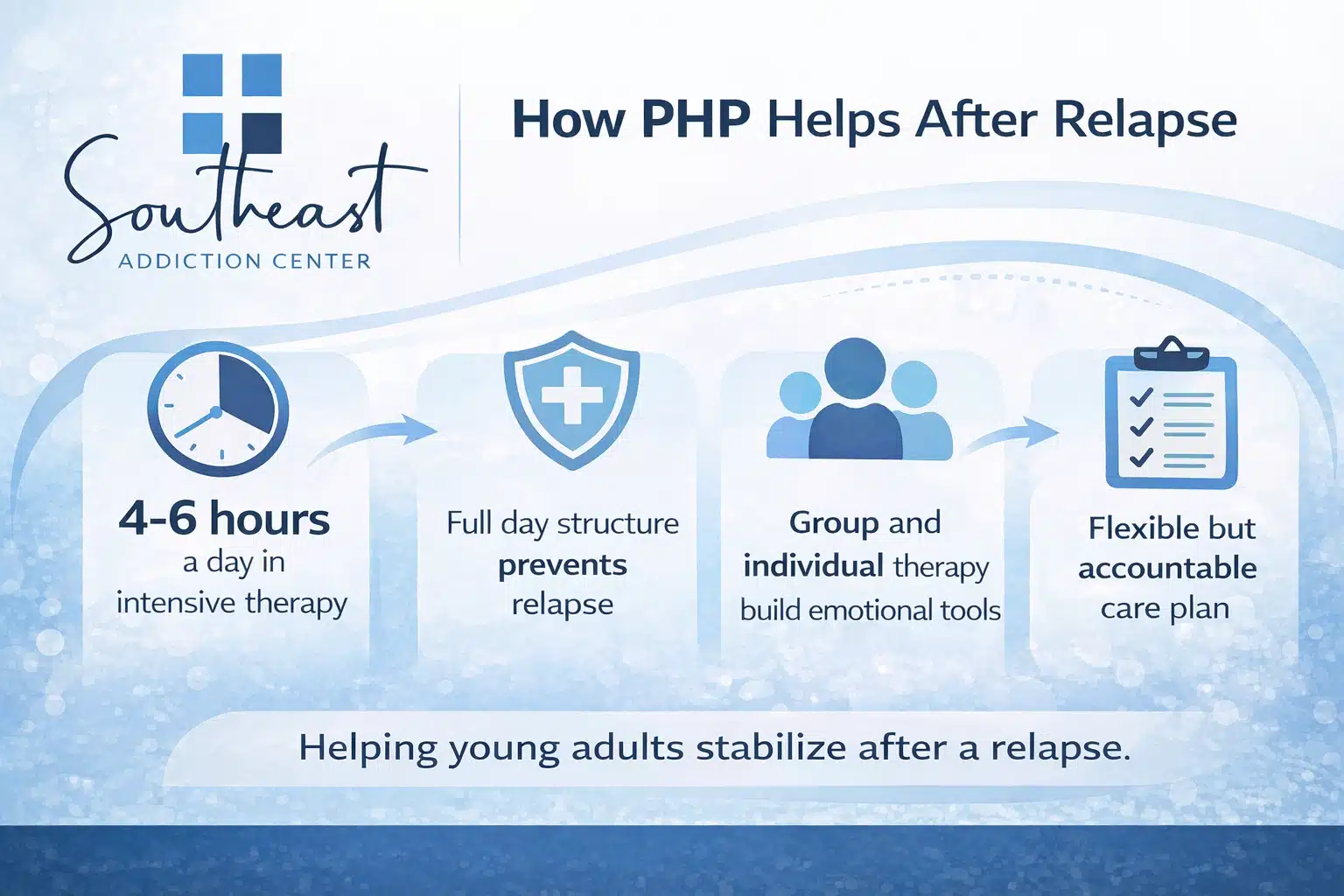
A Partial Hospitalization Program (PHP) is a structured, full-day treatment program that provides intensive clinical care without requiring an overnight stay.
In plain terms: your child spends 5–6 hours a day, several days a week, in a therapeutic environment—then returns home or to sober housing in the evening. It’s more immersive than weekly therapy, but less restrictive than inpatient rehab.
It’s the middle ground that many families don’t realize exists.
Where weekly sessions aren’t enough…
Where inpatient feels too extreme…
That’s where PHP can change everything.
Why PHP Is Often the Right Fit After a Relapse
Relapse isn’t just about drugs or alcohol. It’s often a signal—a sign that something inside has tipped: too much pain, not enough support, or skills that weren’t strong enough to hold up in real life.
That’s where the structure of PHP becomes so powerful.
It gives young adults:
- A daily rhythm that restores safety
- Immediate support for cravings, triggers, or setbacks
- Emotional regulation tools they can actually practice, not just learn about
- A chance to rebuild dignity in an environment that’s therapeutic, not punitive
When they’re using again, your child doesn’t just need rules. They need a new system. One that holds them and challenges them. That’s PHP.
What a Typical Day in PHP Looks Like
PHP at Southeast Addiction is not a one-size-fits-all experience—but it is predictable, consistent, and intentionally designed to promote healing.
A typical day may include:
- Morning group therapy: exploring triggers, coping strategies, and recovery skills
- Individual therapy sessions: deep emotional work and personalized support
- Family involvement: scheduled updates, optional family therapy
- Psychoeducation: learning about how the brain, trauma, and substances interact
- Case management: helping plan next steps for school, work, or continued care
- Lunch and breaks: building social safety, rest, and routine
The pace is full, but not overwhelming. The days are structured, but not rigid.
And most importantly: your child isn’t doing this alone.
PHP Isn’t Just About Sobriety—It’s About the Why
Stopping substance use is just the start. PHP digs deeper.
Many relapsing young adults are struggling beneath the surface with:
- Anxiety or depression
- Past trauma
- Social pressure
- Emotional dysregulation
- Identity confusion or self-worth struggles
If your child left treatment but never learned to regulate emotions or handle disappointment, relapse isn’t surprising—it’s expected.
In PHP, they learn that sobriety is not the same as recovery. They build emotional scaffolding to actually live differently, not just abstain.
Why It Works When Other Things Haven’t
For many families, PHP becomes the “finally” moment.
“Finally, they’re showing up.”
“Finally, they’re opening up.”
“Finally, someone sees them and knows how to reach them.”
Why?
Because PHP is immersive enough to matter—but flexible enough to feel doable. It removes distractions and adds stability. It interrupts the cycle of using, crashing, and isolating without pulling them completely out of the world.
They’re still waking up in their own bed. Still choosing to walk into the building. Still being asked to participate, not just comply.
That difference matters. Especially for young adults who resist being told what to do.
How Parents Can Support Without Taking Over
It’s tempting to want to fix everything. But when your child is in PHP, your role shifts from “rescuer” to “anchor.”
You can:
- Encourage consistency: “I’m proud you went again today.”
- Stay steady when emotions spike.
- Ask what they’re learning—without pressure.
- Let the clinical team hold the boundaries.
- Focus on your support, too. (Yes, seriously.)
At Southeast Addiction Center, we offer guidance for parents too—because you’re part of the system that’s healing, and you deserve support just as much as your child does.
What Real Progress Looks Like
It won’t be overnight. And it won’t be perfect.
Progress in PHP might look like:
- Going two days without using
- Saying “I don’t know” instead of shutting down
- Getting out of bed without a fight
- Making it through group without storming out
- Taking responsibility for one small choice
These are the flickers of healing. The signs your child is thawing. That the wall between you and them is getting thinner.
And it all starts by showing up—again and again—even when it’s hard.
FAQ: What Parents Want to Know About PHP
Do I have to force my child to go?
Ideally, no. PHP works best when the young adult agrees to participate. However, we know that motivation often starts low. Our team can help guide conversations and assess whether it’s time for a stronger intervention or a softer invitation.
Is PHP just rehab by another name?
No. PHP is clinically intensive but not residential. Your child goes home (or to sober housing) after programming each day. It’s a powerful option when inpatient feels too restrictive, but outpatient care isn’t enough.
What if they’ve already tried treatment and relapsed?
That’s more common than you think. Relapse doesn’t mean treatment failed—it means more support or a different approach may be needed. PHP offers a level of care that’s often missing between rehab and traditional therapy.
Can my child still work or go to school while in PHP?
Possibly, but it depends. PHP is a full-time commitment for several weeks, so part-time work or school may need to pause. That said, the goal is to help your child return to life stronger and more stable—and we help them plan for that.
What’s the difference between PHP and IOP?
PHP is more intensive. It typically runs 5 days a week for 5–6 hours a day. IOP (Intensive Outpatient Program) is fewer hours per week. PHP is often the first step after relapse or if daily support is needed.
How do I know if this is the right step?
If your child is using again, isolating, lying, or showing signs of emotional instability—and weekly therapy isn’t helping—PHP may be the right fit. We can walk through the details with you and help assess what level of care makes sense.
There’s Still a Way Forward—Even Now
Watching your child use again is gutting. But this moment does not erase their progress, their potential, or your love.
A Partial Hospitalization Program in Peachtree Corners could be the structure they need to stabilize, reset, and find their way back to themselves.
You don’t have to fix this alone. You just have to reach out.
Call 888-981-8263 to learn more about our Partial Hospitalization Program services in Peachtree Corners, GA.
Hope isn’t gone. It’s just waiting for the next right step. Let’s take it together.